
What your best people know
CAPTURED. SHARED. PROTECTED.
Relationships are your most valuable asset.
Our proprietary Relational IP metrics reveal where they're strong and where they're exposed.
What is Relational IP®?
Every business creates relational intelligence — the trust, context, and understanding built through years of client interactions. It's what makes your best people effective and keeps clients loyal when the work gets hard.
That collective knowledge is your Relational IP: the accumulated experience that powers your reputation and revenue. It lives in people's heads, inboxes, and habits — which means it walks out the door when they do.
Where expectations meet ground truth
Centric measures Relational IP in two ways:
Relational IP Expectations (RIPX)
Captures leadership expectations of the structure and feel of a healthy client relationship
Relational IP Index (RIPI)
Captures how client-facing teams are actually performing in real client interactions
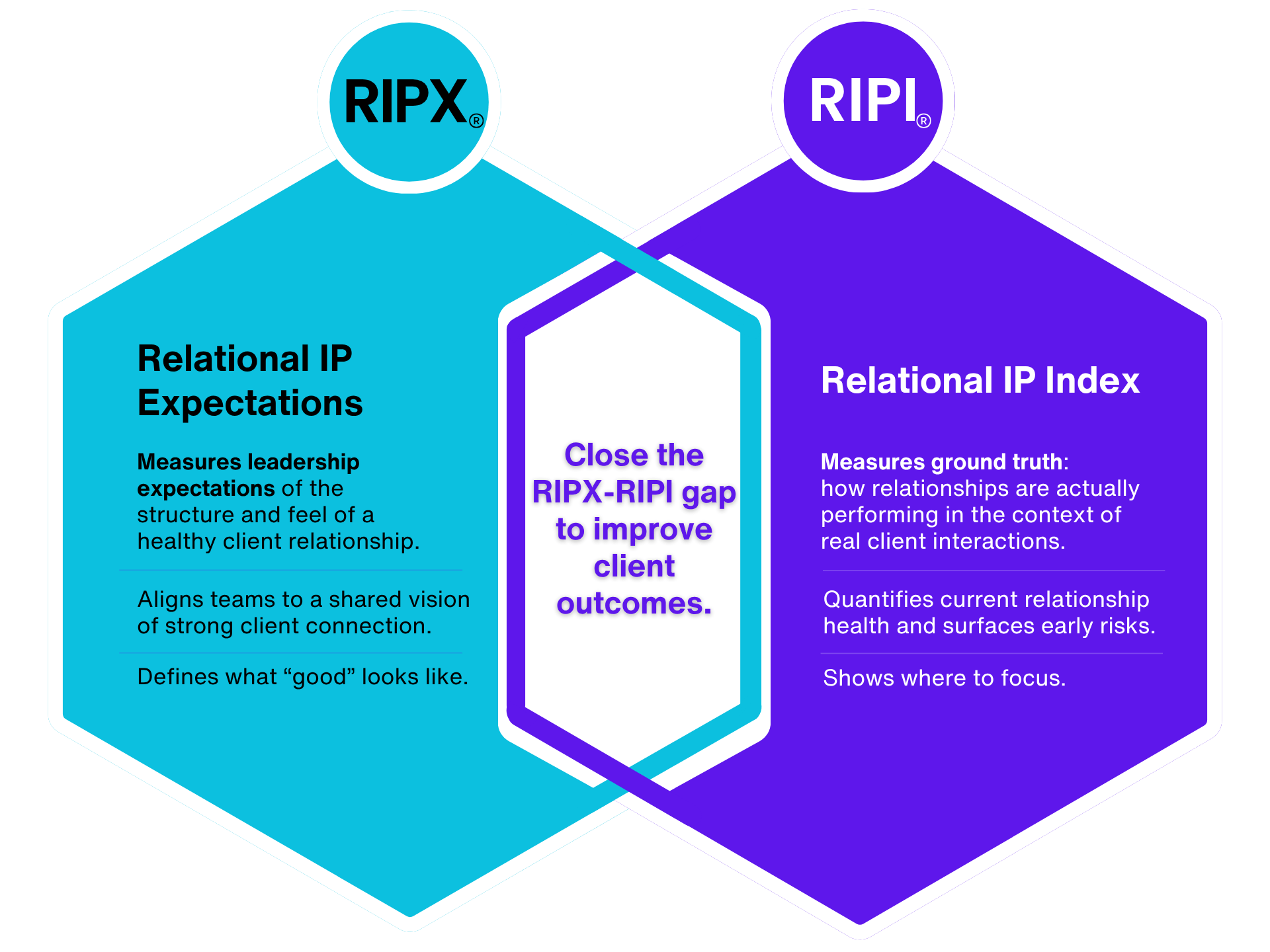
RIPX sets the standard.
RIPI shows the reality.
Together, they tell you
what's working and what needs attention.
The Relational IP® Framework
The vocabulary that makes relationship intelligence measurable, transferable, and defensible.
Relational IP®
The accumulated intelligence that makes a client relationship work — communication preferences, decision-making patterns, organizational dynamics, and the contextual knowledge that tells you how this client thinks, what they value, and what makes them stay. It lives in your people's heads, inboxes, and habits.
Which means it walks out the door when they do.
Relational IP is not CRM data. CRMs record what happened. Relational IP explains why — and predicts what happens next.
Relational IP Expectations (RIPX)
The standard your organization sets for what a healthy client relationship looks like. RIPX is defined by leadership at onboarding — reflecting your firm's culture, your clients' expectations, and the specific deliverables your teams are accountable for producing.
RIPX is grounded in behavioral science: the signals your leadership identifies aren't arbitrary preferences. They are the behavioral indicators — drawn from how humans actually build trust, communicate under pressure, and sustain professional relationships — that predict whether a client relationship will hold.
Centric doesn't tell you what good looks like. Your leadership does. That's the point.
Relational IP Index (RIPI)
Centric's relationship health score — the measure of how your client-facing teams are actually performing across real interactions, right now. RIPI is not scored against a universal standard. It is scored against your RIPX: the expectations your own leadership set.
The methodology is rooted in behavioral science — shaping both what gets measured (the signals that indicate relationship strength or decay) and how performance is scored (based on patterns of human behavior that research connects to trust, loyalty, and retention).
The gap between RIPI and RIPX is where risk lives. Closing it is what Centric is built to do.
Relationship Decay
The gradual erosion of a client relationship — not caused by a single failure, but by the accumulation of small signals that go unnoticed until they become irreversible. Engagement pulls back. Response times lengthen. The tone shifts. By the time it's visible, the decision has often already been made.
Relational Capital
The economic value of your firm's client relationships — the revenue that exists because trust has been built, maintained, and earned over time. Relational capital is the asset underneath your retention rate, your renewal revenue, and your ability to grow existing accounts without the cost of new acquisition.
It appreciates when relationships are healthy and actively managed. It depreciates — silently — when they're not.
Key Person Dependency
The structural risk that exists when a client relationship is held together by one person's knowledge, judgment, and presence — and no one else in the organization knows what they know. The relationship isn't actually with the firm. It's with the individual.
When that person leaves, the client's reason to stay often leaves with them. Key person dependency is the most common and least measured source of client churn in professional services.
Relationship Visibility
The ability to see — clearly, across your entire client portfolio — where relationships are strong, where they are at risk, and where decay has already begun. Most firms operate without it. They find out a relationship is in trouble when the client tells them, or when they don't.
Relationship visibility is what Centric provides. It turns the invisible into the measurable — before the cost of not knowing becomes the cost of losing.
Keep the clients you've already earned.
Centric helps you measure and protect your Relational IP — giving you a clear view of client relationship strength, continuity, and risk.
Protect Your Relational IP